
The lake beneath the lake is real, it is massive in volume compared to the GSL (globally the volume of fresh groundwater is roughly 100 times that of fresh surface water), is ancient, and very challenging to extract without undesirable consequences.
by D. Kip Solomon, Distinguished Professor, University of Utah
co/author of: Airborne geophysical imaging of freshwater reservoir beneath the eastern margin of Great Salt Lake
In 2024 graduate students Sam Carter and Eben Adomako-Mensah started extracting water out of the pores of sediment cores collected from Farmington Bay. They found a thin layer of hypersaline water that transitions to fresh water about 4 m below land surface. Previous geophysical measurements made by Mike Thorne and Mason Jacketta were consistent with this thin hypersaline layer above fresh water and airborne geophysical measurements analyzed by Michael Jorgensen and Michael Zhadonov have shown that fresh water in sediment pores extends to more than 3 kilometers in places beneath Farmington Bay. Near the surface, the volume of pores space between grains of sediment is nearly 50% of the total volume. While this porosity decreases with depth it is likely that an average of about 30% of the more than 3 km of sediments is water! In other words, if all this water was removed from these pores and ponded on the surface, it would create a lake the area of Farmington Bay that is more than 1000 m deep!
Piezometers (small diameter wells) installed to various depths along the Antelope Island Causeway reveal that this fresh water is under artesian pressure such that water will flow without a pump (think of the artesian well located in Salt Lake City on the corner of 5th East and 8th South). These pressures are being continuously monitored by Hugh Hurlow’s team at the Utah Geological Survey. Sam Carter and Scott Hynek (U.S. Geological Survey) sampled these and existing production wells for analyses of trace amounts of stable and radioactive isotopes, dissolved noble gases and major ion chemistry. These analyses indicate that the fresh water (1) entered the ground at high elevation in the Wasatch Mountains to the east of Farmington Bay, (2) moved slowly through the subsurface at rates up to 200 m/yr near the range front, (3) discharges mostly into wetlands and streams on the fringe of Farmington Bay, and (4) is likely more than 10,000 years old beneath the Bay. This makes sense because 15,000 years ago freshwater Lake Bonneville occupied the basin and the saline Great Salt Lake has only been at its present level for about 13,000 years.
Work by Bill Johnson and Eben Adomako-Mensah has shown that this ancient, pressurized groundwater is naturally discharging in discrete locations creating round “oasis” (round spots) at rates that are essentially matched by evaporation and transpiration from Phragmites (reed-like invasive grass). An analysis of the downward migration of hypersaline water near the surface via chemical diffusion shows that it is being modulated by the slow upward migration of fresh water. In other words, salty Great Salt Lake water is trying to migrate downward due to both gravity and diffusion, but that movement is opposed by slow, but persistent, upward movement of pressurized groundwater.
So, is extracting this ancient, pressurized water a simple solution to refilling GSL? The sediments beneath Farmington Bay are generally very fine-grained silts and clay that have significant porosity but low permeability (a measure of how easily water can flow through the sediments). As a result, extracting this massive volume of water would be challenging. Available permeability data suggest that extracting enough water from flowing wells to match evaporation would require tens of thousands to tens of millions wells in just Farmington Bay (think of the number of oil and gas wells in western Wyoming or the Permian Basin in Texas). The exact number of wells depends on the coarseness of the sediments which is not well known, but in almost all possibilities the numbers are staggering. Moreover, unlike the sustainable use of groundwater where extractions are less than replenishment, the long-term use of this ancient groundwater would not be sustainable.
Aside from the extraction difficulties, there other issues regarding the use of groundwater beneath the lake. First, existing data pertain mostly to Farmington Bay. There are reasons to suspect that significant fresh or brackish water also exists beneath the main body of GSL, but hydrologic conditions there are largely uninvestigated. Second, when groundwater is removed from storage, sediments consolidate and the land surface drops. For example, in Mexico City the land surface has dropped more than 30 m due to groundwater pumping. While this might lead to a deeper GSL with more storage volume for the same surface area (which controls evaporation), subsidence could propagate to developments adjacent to the lake resulting in foundation problems. Third, heavy extraction of groundwater could reverse the current hydraulic gradient causing GSL water to move downward resulting in an additional sink for the GSL water budget.
So, the lake beneath the lake is real, it is massive in volume compared to the GSL (globally the volume of fresh groundwater is roughly 100 times that of fresh surface water), is ancient, and very challenging to extract without undesirable consequences. Utilizing ancient groundwater is not inherently unsustainable if extractions do not exceed recharge. Ongoing research is aimed at better quantifying the rates of recharge which might result in some limited and sustainable ways to utilize this ancient resource. Stay tuned!
About the author
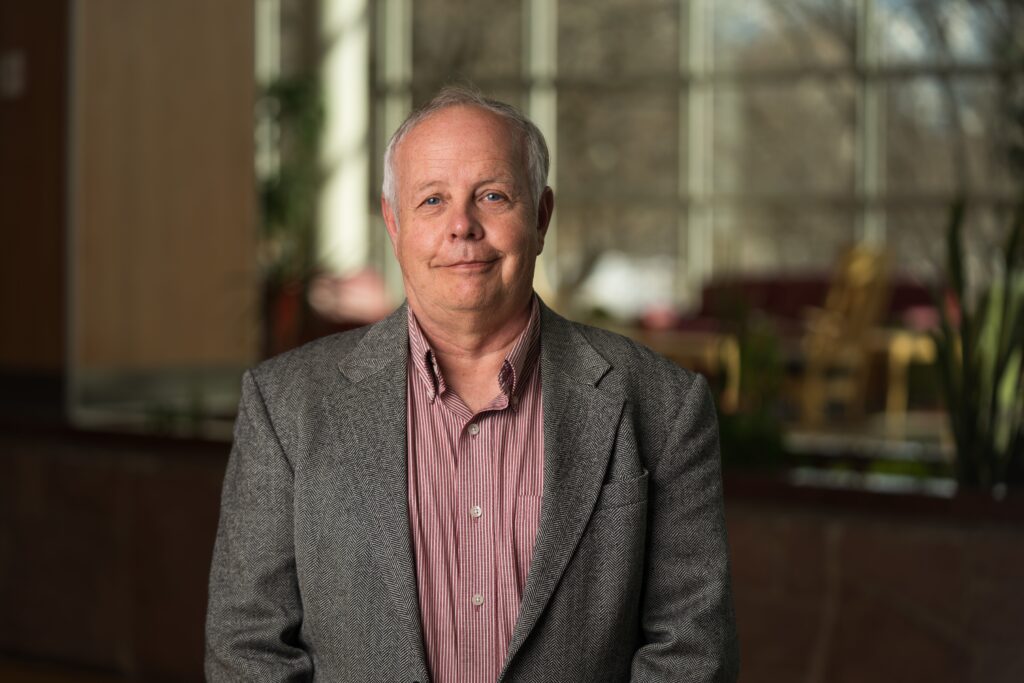
D. Kip Solomon is a Distinguished Professor at the University of Utah where he currently holds the Brown Presidential Chair in the department of Geology and Geophysics. His education includes a Ph.D. (1992) in Earth Sciences from the University of Waterloo, an M. S. (1985) in Geology from the University of Utah, and a B.S. (1979) in Geological Engineering from the University of Utah. He is a Fellow of the Geological Society of America (GSA), a Fellow of the American Geophysical Union, and the 2026 recipient of the Governor’s Medal for Science and Technology. He was previously employed by Oak Ridge National Laboratory in various positions ranging from Research Staff to Groundwater Group Leader. He has been the United States Representative for various Advisory Groups at the International Atomic Energy Agency, and on the editorial board for the journal Ground Water. He was previously appointed as the Darcy Lecturer by the National Groundwater Association and was the Chair of the Hydrogeology Division of GSA.
Dr. Solomon’s research includes the use of environmental tracers to evaluate groundwater flow and solute transport processes in local- to regional-scale aquifers. He has help develop the use of dissolved gases including helium-3, CFCs and SF6 to evaluate groundwater ages, travel times, location and rates of recharge, and the sustainability of groundwater resources. He constructed and operates one of only a few labs in the world that measures noble gases in groundwater. His research results have been documented in more than 160 journal articles, book chapters, and technical reports.